
The Eastern Schools for the Deaf Athletic Association (ESDAA) traces its roots to 1927, when Fred Moore, a teacher at the New Jersey School for the Deaf (now the Marie H. Katzenbach School for the Deaf), organized a boys’ basketball tournament involving Deaf schools from the eastern United States. Over time, this tradition of bringing Deaf schools together for athletic competition grew into a formal association and expanded to include multiple sports.
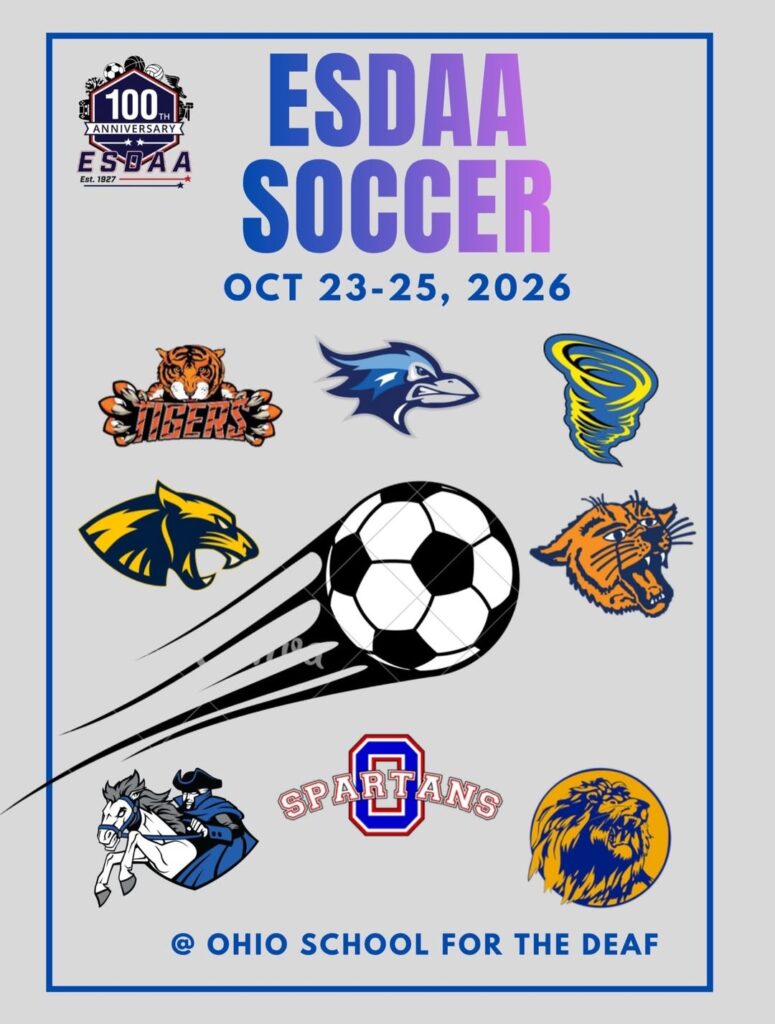
ESDAA organizes tournaments for its member schools, promoting sportsmanship, teamwork, and fair competition. To accommodate schools of different sizes, soccer competitions are divided into Division 1 and Division 2.
The association’s soccer program evolved from regional competitions, including New England, Upstate, and Metro, into the two-division format used today.
The ESDAA Soccer Tournament was held at the Ohio School for the Deaf on October 23–25, 2027, with eight Deaf schools participating. ESDAA uses an eight-player format, reducing the number of players from the traditional 11-player game. This format accommodates Deaf schools with smaller rosters and makes it easier for them to compete.
A full-size soccer field under FIFA standards measures 100–130 yards long and 50–100 yards wide. For eight-player soccer games, the field is generally smaller, measuring approximately 70–80 yards long and 45–55 yards wide, depending on the applicable rules. For the ESDAA Tournament, the Ohio School for the Deaf (OSD) uses a reduced field measuring 85 yards long by 50 yards wide.
ESDAA officers are elected by the athletic directors representing the association’s 17 member schools. They also discuss and determine the tournament seeding for the eight participating teams. Seeding considerations include the number of graduating senior players lost from the previous season, each team’s record, and its results against other Deaf schools. These factors help determine each team’s seed in the tournament bracket.
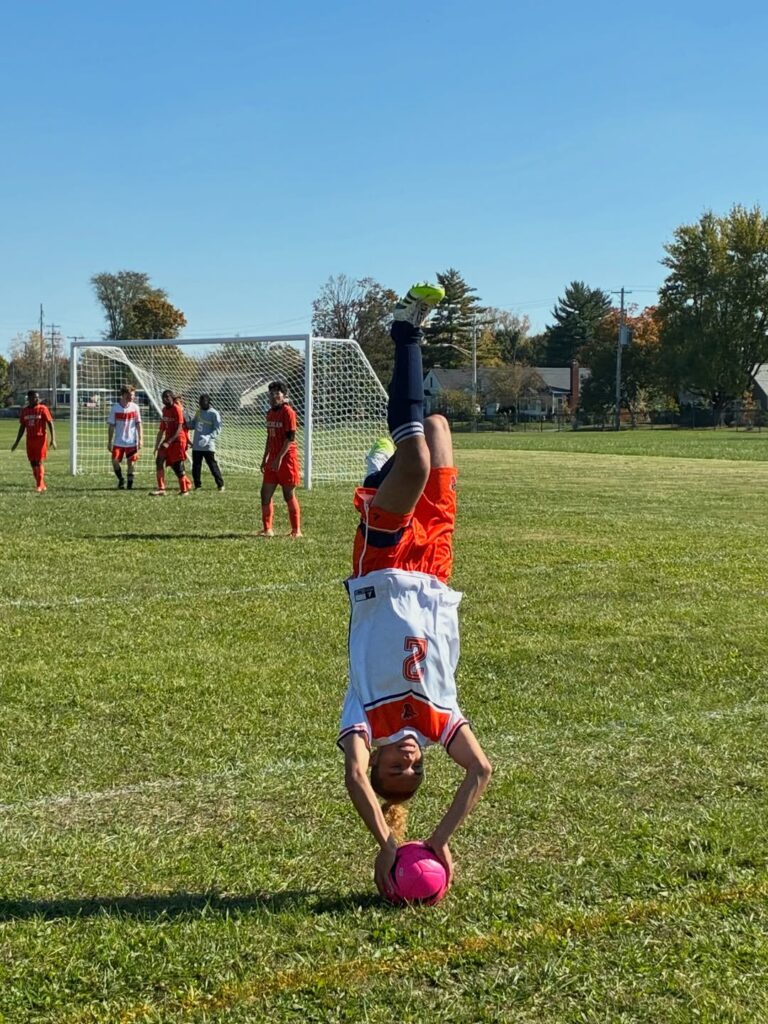
An interesting aspect of soccer competition is the color of the balls used during games. Some players have visual difficulties distinguishing certain colors, so teams may use different-colored balls if both coaches agree. The Ohio School for the Deaf (OSD) uses a pink ball, while the Western Pennsylvania School for the Deaf (WPSD) uses a lime-yellow ball.
ESDAA respects the needs of players from different schools and supports fair competition by allowing reasonable accommodation when both coaches agree.
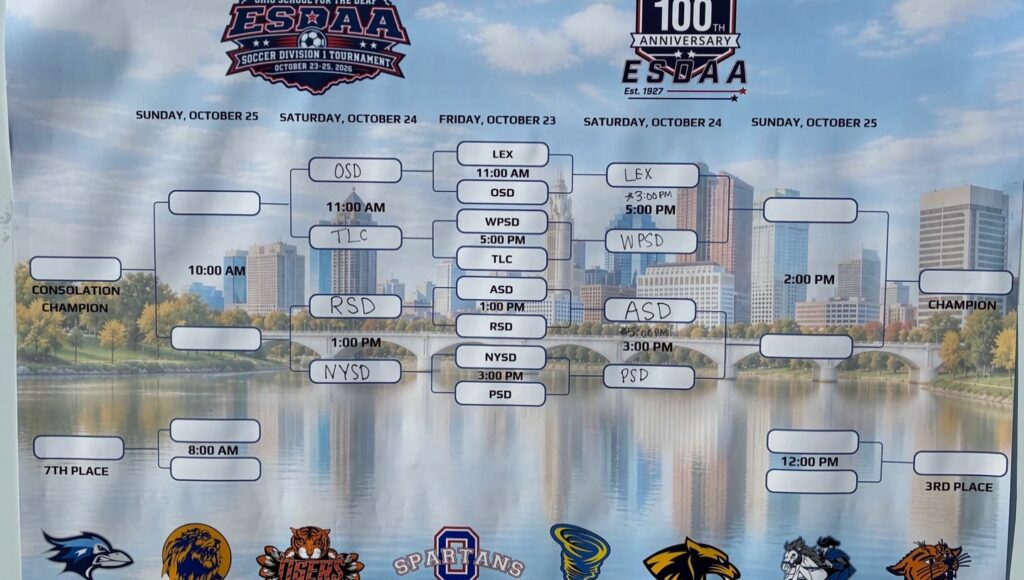
On Friday, the tournament opened with four games. At 11:00 a.m., the Ohio School for the Deaf (OSD) faced the No. 1 seed, Lexington School for the Deaf (LSD). The game was stopped at halftime, with LSD leading 12–0.
At 1:00 p.m., the No. 3 seed, American School for the Deaf (ASD) from Connecticut, defeated the No. 6 seed Rochester School for the Deaf (RSD), 8–1.
At 3:00 p.m., the No. 7 seed, Pennsylvania School for the Deaf (PSD) from Philadelphia, upset the No. 2 seed, New York School for the Deaf from Fanwood (NYSD), 4–2.
In the final game, the No. 4 seed, Western Pennsylvania School for the Deaf (WPSD), defeated the No. 5 seed, The Learning Center (TLC) from Massachusetts, 5–0. WPSD’s Adam P. scored three goals, while Christian B. scored twice, including one penalty kick.
Early Saturday morning, ESDAA held several individual and team competitions to test the players’ soccer skills.
- Shooting Competition – Each participant had three balls placed on the penalty kick line. The time started when the first ball was kicked and ended when the final ball crossed the goal line or came to a complete stop. Points were awarded based on the competition rules.
- Individual Shooting Champion – The winner was determined by the highest individual score, with the fastest time used as a tiebreaker.
- Team Shooting Champion – The winning team was determined by the highest combined score, taking timing into account.
- Goalie Kick – Each school’s goalie had three attempts to achieve the longest kick.
- Goal Kick – Each school had two defenders and one goalie, with three attempts to achieve the longest kick.
At 11:00 a.m., the Ohio School for the Deaf (OSD) lost to The Learning Center (TLC), 13–6. OSD’s Daniel H. scored four goals, while his teammate Lucas M. added two goals. After lunch, the New York School for the Deaf (NYSD) defeated the Rochester School for the Deaf (RSD), 10–3, while the Western Pennsylvania School for the Deaf (WPSD) fell to the Lexington School for the Deaf (LSD), 8–1. WPSD’s only goal was a penalty kick scored by Christin B.
What an exciting game in the late afternoon! The Pennsylvania School for the Deaf (PSD) scored a late goal to tie the game at 4–4. After two overtime periods, the score remained tied. The American School for the Deaf (ASD) won the shootout, 2–1.
For seventh and eighth place, Rochester School for the Deaf (RSD) edged the Ohio School for the Deaf (OSD), 5–4. In the fifth- and sixth-place game, Fanwood’s New York School for the Deaf (NYSD) defeated The Learning Center (TLC), 5–2.
In the Battle of Pennsylvania for third place, the Pennsylvania School for the Deaf (PSD) edged the Western Pennsylvania School for the Deaf (WPSD), 5–4, in a close game. WPSD’s Christin B. scored three goals, including one on a corner kick, while Adam P. added another goal. Goalie Jreem made numerous saves to keep WPSD in the game.
In the championship game, Lexington School for the Deaf (LSD) defeated the American School for the Deaf (ASD), 7–0. ASD played with only six players on the field after halftime.
At the awards ceremony, medals, plaques, and trophies were presented to recognize outstanding players, individual skills competition winners, and the winning teams. WPSD’s Christin B. and Adam P. were selected as All-Tournament Players.
Written by Stephen Rute